Newsletter Subscribe
Enter your email address below and subscribe to our newsletter

 Bygonzay
Near Field Communication (NFC) is a short-range wireless communication technology that enables devices to exchange data by being placed close together, typically within a few centimeters. It powers many everyday conveniences, including contactless payments, digital ticketing, smart access systems, and quick device pairing.
Today, NFC is widely used in smartphones, smartwatches, payment terminals, transportation systems, and smart home devices. This guide explains what NFC technology is, how it works, its key features, benefits, applications, challenges, and best practices.
Near Field Communication (NFC) is a wireless communication standard that allows compatible devices to exchange small amounts of data over very short distances, usually within 4 centimeters (about 1.5 inches).
NFC is based on radio frequency technology and enables secure, fast, and simple communication without requiring manual device pairing.
NFC devices communicate only when they are held very close to each other, helping reduce accidental connections.
NFC uses radio waves to transmit information between compatible devices.
Unlike many wireless technologies, NFC typically establishes a connection automatically when devices are placed close together.
Once connected, devices can exchange information such as payment credentials, contact information, or authentication data.
A smartphone or NFC reader reads information stored on NFC tags.
Examples include:
The device behaves like a contactless payment card or digital access card.
Common uses include:
Two NFC-enabled devices exchange information directly.
Examples include:
The limited operating distance improves convenience while reducing unintended connections.
NFC devices connect almost instantly without lengthy setup procedures.
NFC requires very little power, making it suitable for mobile devices and passive tags.
Users often only need to tap or hold devices close together.
The short operating range helps reduce the risk of unauthorized interception during communication.
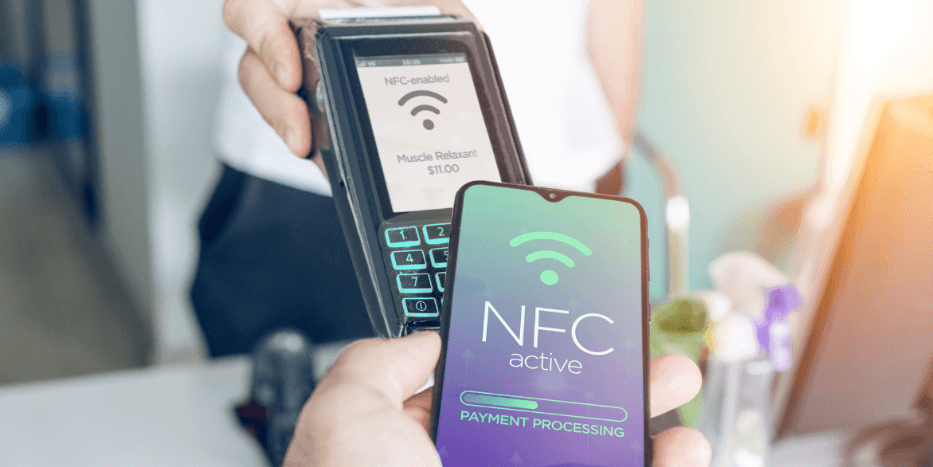
Users can pay by tapping a smartphone, smartwatch, or contactless card on a compatible payment terminal.
NFC can simplify connecting wireless accessories such as speakers or headphones by initiating the pairing process.
Contacts, website links, and other small amounts of data can be exchanged quickly between compatible devices.
The tap-and-go approach makes many everyday interactions faster and easier.
Contactless interactions are convenient for payments, ticket validation, and access control.
NFC powers secure contactless payments at retail stores and other compatible payment locations.
Transit systems use NFC-enabled cards and mobile wallets for ticket validation.
Organizations use NFC-enabled badges and smartphones for secure building entry.
Professionals can share contact details by tapping compatible devices or NFC cards.
Some smart home products use NFC for quick setup and automation.
NFC can assist with patient identification, equipment tracking, and secure access to medical information.
Retailers use NFC tags for product information, promotions, and customer engagement.
An NFC tag is a small chip that stores information readable by compatible NFC-enabled devices.
Tags can contain:
Many NFC tags are inexpensive, reusable, and require no internal power source.
NFC only works over very short distances, making it unsuitable for long-range communication.
Both devices must support NFC for many features to work properly.
NFC is designed for exchanging relatively small amounts of information rather than large files.
Not every smartphone, wearable, or payment terminal includes NFC functionality.
Turning NFC off when it is not being used may help conserve battery life and reduce unnecessary wireless activity.
Only make contactless payments through reputable financial institutions and authorized payment applications.
Ensure you are interacting with trusted payment terminals, NFC tags, or access systems.
Install operating system and security updates to benefit from the latest protections and performance improvements.
Use a screen lock, biometric authentication, or a strong passcode to help secure NFC-enabled services.
Completes many actions with a simple tap.
Consumes very little power during operation.
Requires minimal setup and user interaction.
Supports payments, identification, automation, ticketing, and data sharing across many industries.
NFC (Near Field Communication) is a short-range wireless technology that enables compatible devices to exchange data when they are brought close together.
NFC is commonly used for contactless payments, digital ticketing, access control, device pairing, information sharing, and reading NFC tags.
NFC is generally considered secure for many applications because it operates over a very short distance. However, users should still protect their devices with screen locks, biometric authentication, and trusted payment services.
No. Many modern smartphones include NFC, but support varies depending on the manufacturer, model, and region.
Yes. Many NFC functions, such as reading NFC tags or initiating certain device interactions, can work without an internet connection. However, some services, such as payment verification or cloud-based features, may require network connectivity.
NFC technology has become an essential part of modern digital life, enabling fast, secure, and convenient interactions through simple tap-to-connect functionality. From contactless payments and public transportation to smart home automation and secure access systems, NFC continues to simplify everyday tasks across many industries. As more smartphones, wearables, and connected devices adopt NFC capabilities, this technology will remain a key component of seamless and secure wireless communication.